
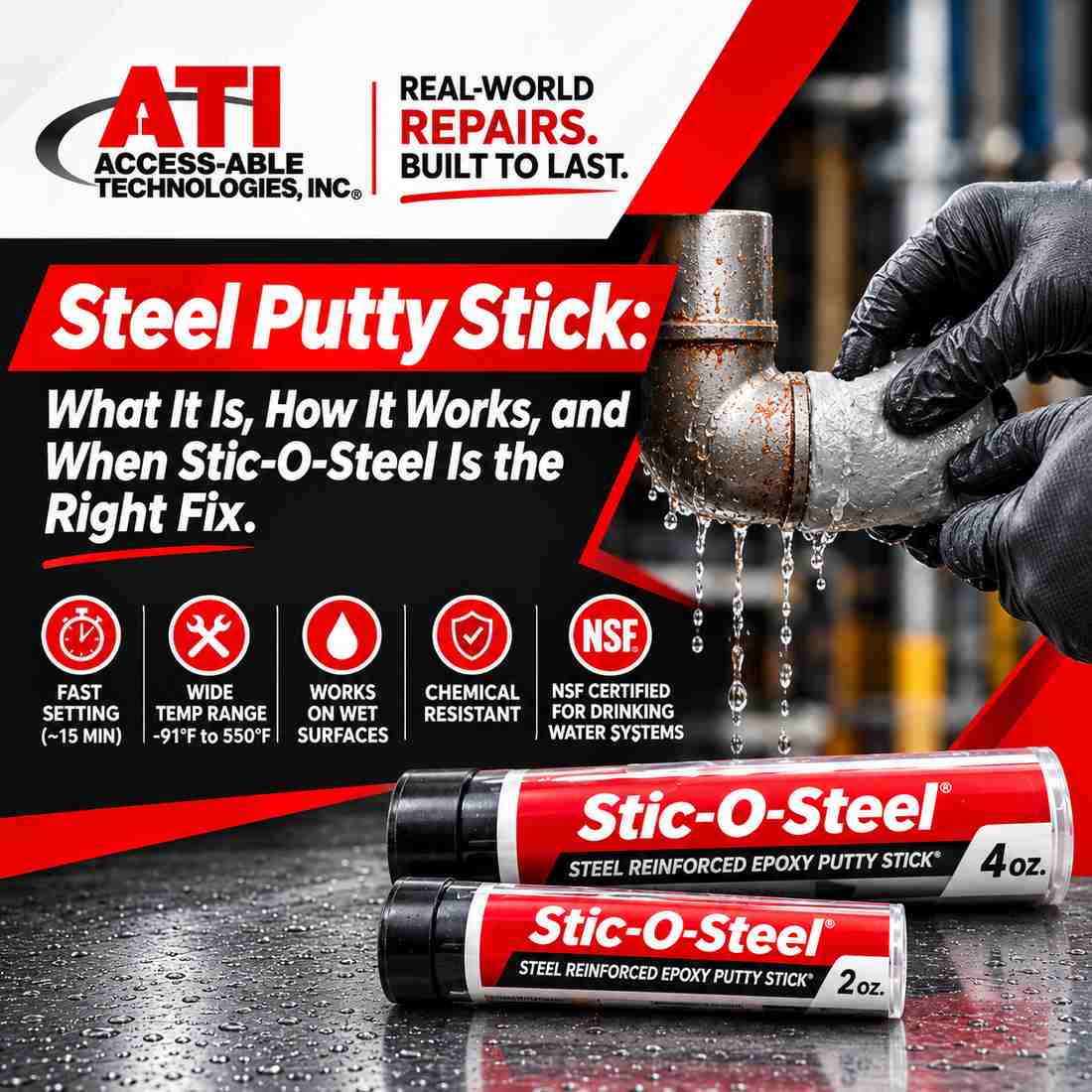
Steel Putty Stick: What It Is, How It Works, and When Stic-O-Steel Is the Right Fix
You know the moment. A threaded hole is stripped, a tank is seeping, or a metal bracket has a crack right where it matters. The part isn’t worth replacing, and you don’t have time to weld.
That’s what a steel putty stick is for. You may have searched for it as “steelstik epoxy putty” or “steel stik.” The names vary, but the idea is the same: a two-part epoxy you knead by hand, press into the damage, and let harden into something that behaves a lot like metal.
Here’s how it works, and how to use Stic-O-Steel well.
What Is a Steel Putty Stick?
A steel putty stick is a stick of epoxy putty with two parts inside. The outer layer is the resin. The core is the hardener. Nothing happens until you cut off a piece and knead the two together. After that, the clock starts.
Stic-O-Steel adds steel reinforcement to a high-grade epoxy base. That’s why it holds up where ordinary glue won’t. It’s a putty, not a liquid, so it stays where you put it. You can pack it into a gap, build up a worn edge, or smooth it over a pinhole leak.
How Fast Does It Set?
Fast, which is the main reason people reach for it. According to the product details:
- Working time: about 4-5 minutes after mixing
- Hard as steel: around 15 minutes
- Fully cured: within one hour
After that hour, you can drill it, tap it, file it, sand it, prime it, and paint it. Repairs that used to need a trip to the hardware store, or a welder, can be finished before lunch.
It Works on Wet Surfaces, Even Underwater
This is where Stic-O-Steel stands apart from most repair products. It bonds to wet surfaces, underwater, and even inside chemicals. You can patch a container or tank with liquid still in it, so you don’t have to drain it first.
That matters on boats, in utility rooms, and around anything that leaks while you’re trying to fix it. Many adhesives need a dry surface. This one doesn’t.
How Tough Is It?
The specs are worth knowing before you trust a repair to it:
- Heat range: from -91°F (-68°C) up to 550°F (288°C)
- Hardness: D-87 on the Shore scale once cured
- Tensile strength: 6,000 psi
- Chemical resistance: shop fluids, gasoline, diesel, antifreeze, solvents, oils, and caustic fluids like battery acid
- Corrosion: it doesn’t rust or oxidize
- Shelf life: at least 3 years
It’s also NSF certified for repairs on drinking water pipes, tanks, and systems. That’s a useful detail if you’re fixing something that carries water people will drink.
Where People Actually Use It
Metal repair is the obvious job, but the list is longer than most people expect:
- Plumbing: small leaks, cracked fittings, and seeping joints
- Automotive and shop work: stripped threads, cracked housings, and worn surfaces
- Marine: repairs on hulls, tanks, and fittings, including below the waterline
- Home and workshop: loose handles, broken brackets, and damaged metal furniture
- Industrial maintenance: quick fixes on pumps, valves, and tanks that keep a line running until a proper replacement arrives
If your project is a larger pipe leak rather than a patch or a gap, take a look at Pow-R Wrap, which is built for that job.
How to Use a Steel Putty Stick (Step by Step)
- Prep the surface. Wipe off loose rust, dirt, and grease. It tolerates wet surfaces, but a cleaner surface still bonds better.
- Cut a piece. Slice off just what you need. A little more than you think is better than not enough.
- Knead until the color is uniform. No streaks of two colors. This is the step people rush, and it’s the one that matters most.
- Press it in firmly. Work it into the crack, hole, or gap. Don’t just lay it on top.
- Shape it fast. You have roughly 4-5 minutes. A wet fingertip helps smooth the surface.
- Leave it alone. Let it harden for 15 minutes, then give it a full hour before drilling or sanding.
Always follow the directions on the package, especially for anything under pressure or anything that carries drinking water.
Which Size Should You Buy?
Stic-O-Steel comes in two sizes:
- The 2 oz stick is $4.99. It suits one small repair, a toolbox backup, or a glove-box emergency fix.
- The 4 oz stick is $9.49. It’s the better pick for larger gaps, multiple repairs, or a workshop shelf.
Because the shelf life is at least three years, keeping an extra stick around isn’t wasteful.
Pairing It With Other Repair Products
A putty stick is great for patching, filling, and rebuilding. Some jobs need a different tool, and the Access-Able Tech line covers several:
- Pow-R Glue for bonding jobs
- Pow-R Patch for patching
- Pow-R Shield for protective coverage
- Freeze-Fix for cold-weather mishaps
You can browse the whole lineup on the products page, or go straight to the online shop.
Common Questions
Is “steelstik epoxy putty” the same as Stic-O-Steel?
People use several names for the same product type: steel putty stick, steel stik, epoxy stick. Stic-O-Steel is Access-Able Tech’s version, a steel-reinforced epoxy putty stick.
Can I use it on a leak that’s still running?
It bonds to wet surfaces and works underwater, but for anything under pressure, follow the package directions or ask the team first.
Can I paint over it?
Yes. After the full cure, you can sand, prime, and paint it.
Is it safe for drinking water systems?
It’s NSF certified for repairs on drinking water pipes, tanks, and systems.
More answers are in the FAQ page, and you can read what other customers say on the testimonials page.
Final Thoughts
A steel putty stick won’t replace a weld on a structural beam. For everyday jobs like leaks, cracks, stripped holes, and worn edges, it’s fast, cheap, and strong enough to last. Stic-O-Steel sets in minutes, handles wet conditions, and cures into something you can drill and paint.
Need help choosing? Call 800-572-4894 or contact the team. Running a facility or crew? See the commercial customers page. Or just grab a Stic-O-Steel stick and keep one handy.